
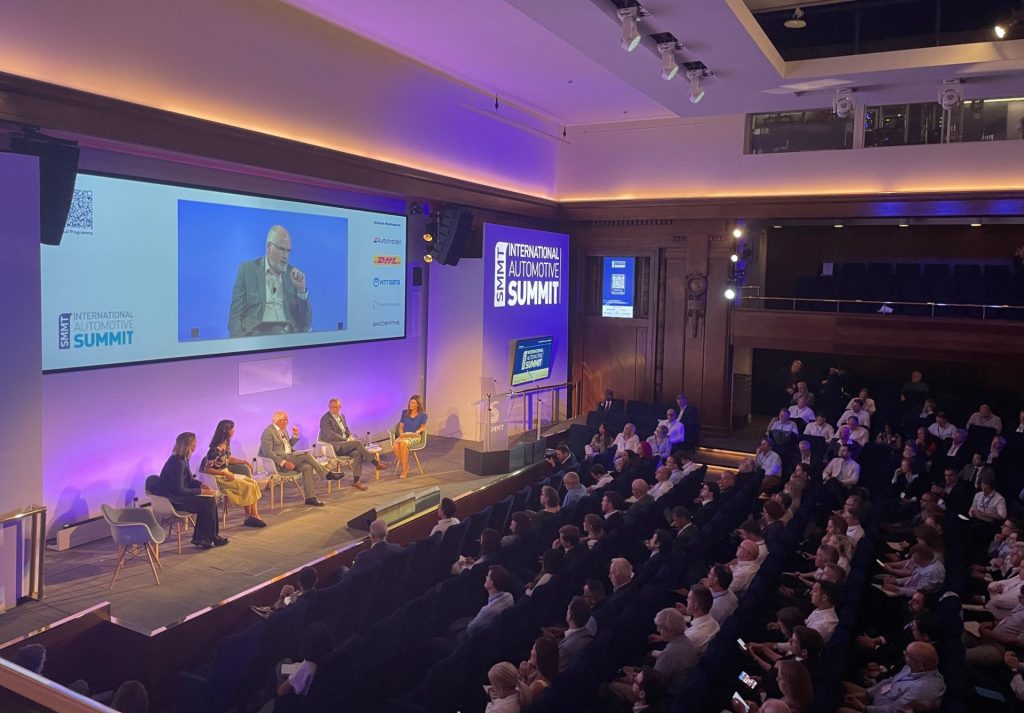
Experts from the automotive sector gathered together at the annual SMMT Automotive Summit. All the key topics facing the sector were discussed from geopolitics and trade, sustainability in the sector, developments in ZEV transition and of course, the Industrial Strategy.
The Industrial Strategy – the view from Westminster
Jonathan Reynolds MP, Secretary of State for Business and Trade and President of the Board of Trade
“I genuinely do believe that this sector typifies the best of British industry. Automotive is and should be a flagship for our mission to make the UK a green energy superpower. That’s why the Chancellor announced an additional government investment of £1.8bn pounds to support the uptake of EVs and improve charging infrastructure as part of the recent Spending Review.
“Through the Industrial Strategy we are going to go further still together. I promise this won’t just be a talking point for a week, a month or a year; it’ll be something that in ten years’ time we can look back on as an important milestone for this industry and as the foundations for the sector to succeed into the future.

“This plan is the first time that the whole of government has been united behind a single strategy. Our Advanced Manufacturing Sector Plan sets out how the UK will solidify itself as the best place in the world to start to grow and to invest in advanced manufacturing. In practice, that means an ambition to nearly double the annual business investment in the sector by 2035 and in automotive context, that means growing our output to over 1.3 million vehicles by 2035, helping to stabilise and grow our supply chain.
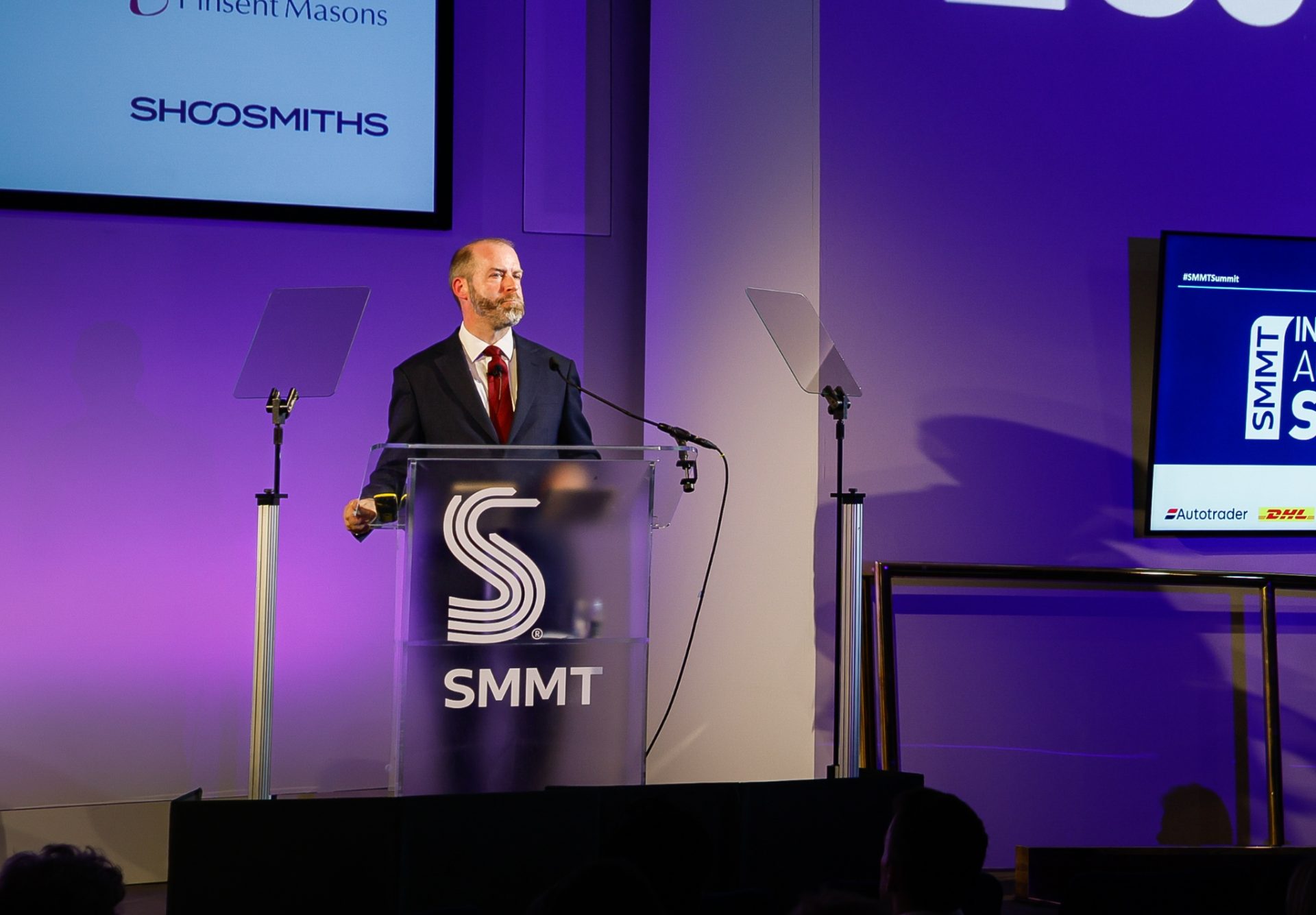
“We’ll also be using the Industrial Strategy to tackle the sky high electricity costs that UK manufacturers have faced for years, and from 2027, the new British Industrial Competitiveness Scheme, will reduce electricity costs by up to £40 per megawatt hour for over 7,000 electricity intensive businesses in manufacturing, many of them within the automotive sector.
“We also know that 80% of UK made cars are exported, so improving trade conditions is one of the most important things we can do. As such, we’ve already taken some big steps in that direction by signing three landmark trade deals in the space of a month.
“Our upcoming trade strategy, set to be published this week, will set out the game plan for the future, our ambition to improve competitiveness and to increase the resilience in the UK automotive supply chain. I’m indebted to the work of this sector, the Automotive Council and of course, to the SMMT itself, for the intelligence and the insights that have helped to inform this strategy and to help us navigate what has been a difficult global environment.”
Andrew Griffith MP, Shadow Secretary of State for Business and Trade
“I’m optimistic about the future of our country. The world still wants what we make, and even more so, it wants our skills, knowledge and experience. But as a former businessman of 25 years, I am deeply concerned.
“While we welcome the Prime Minister’s epiphany on energy costs, which has enabled the start of a process of slashing the additional green costs of energy, unfortunately, there is a long, long way to go. The vast majority of businesses in this country, including almost all small and medium sized enterprises, will not benefit from the Industrial Strategy. And even after the benefits finally appear in 2027, British manufacturers of all kinds will still face the highest industrial energy costs in the OECD. That is no basis on which our country can compete for the long-term.
“The imposition in the small print, of the UK Carbon Border Adjustment Mechanism, is a tariff by another name, and it is simply wrong for people to rail against tariffs when they are introduced unilaterally by the US, and then to do precisely the same under the guise of climate here at home.
“Energy costs in Birmingham, Alabama, are four times lower than in Birmingham, West Midlands. That is no basis on which to compete, and yet this UK government has slammed the brakes on exploitation of North Sea oil and gas, giving us secure energy under our feet.
“We must also confront the reality that not one single person around the cabinet table has real business experience; to know what it’s like to take a risk, from signing off investment on a factory or new production line, to hire employees or the ability to raise capital, debt or equity, and then make a promise to shareholders to make a return on that.
“The direction we’ve seen from this government so far is regrettable. We’re seeing an exodus of capital as one millionaire leaves this country every 45 minutes, and now we have to manage the challenge of a 300-page Employment Rights Bill, which will drown businesses in red tape. That’s not the support that this brilliant sector needs, and particularly not at a time of such intense global competition.”
The view from Industry
With UK automotive’s potential to add £50bn to the economy during the next decade, it is vital that the right framework, regulation and investment are at the heart of government’s focus. This SMMT Automotive Summit panel looked at how the UK’s new Industrial Strategy can deliver for the sector. The panellists discussed risks and opportunities, as well as what is needed to ensure success.
Mike Hawes, Chief Executive of the Society of Motor Manufacturers and Traders (SMMT)
- “Government’s long-term Industrial Strategy, including the Drive35 £2.5bn auto capital and R&D fund, recognises automotive as a pillar of advanced manufacturing, integral to the world leading innovation that creates the high value jobs, wealth and economic growth that are vital to our country’s future. Now we must make the most of that position and put in place the right conditions for growth.”
- “With action to reduce electricity costs, upskill workers and unlock finance, it lays the foundation on which we can build our future. We now need to see the strategy implemented and at pace, because competitors will move fast so our window of opportunity will not remain open for long. The prize, however, in terms of jobs, innovation and economic growth – green growth at that – is worth the investment.”
Steve Turner, Assistant General Secretary, Manufacturing, Unite the Union
- “We’ve got a whole series of issues that need to be addressed, one of which is trying to address the question of low volume production in the UK. However, there’s no real plan about how we’re going to get there. We’re not going to do achieve our ambitions of 1.3-1.5 million vehicles with the current footprint of plants in the UK, so we need to attract investment. So how do we support the UK supply chains? We’re very innovative in the UK. We’re fantastic at being cutting-edge in terms of technology, digital advances etc. But we’re not good at industrialising that and utilising the talent that we’ve got to bring manufacturing to the UK and retain it.”
- “The whole question about how we create those supply chains still remains open to us, but there’s great things in the Industrial Strategy and there’s some real opportunities.”
Phil Jones, Managing Director, Leyland Trucks
- “We welcome this strategy. I think the duration of it is important as it sets out our long-term view when we’re pitching for investment in the UK, rather than in other plants in Europe or the US.”
- “In terms of skills, we have used the Apprenticeship Levy effectively in our business but as we transition our products, to meet the what will be the varied needs of our users, we will need our people to drive forward a super-flexible factory to meet the duty cycle needs of our customers.”
- “We’ve been manufacturing trucks at Lancashire for 130 years and we have some long-standing employees doing. So we need to bring our workforce along with us as we transition.”
The automotive landscape
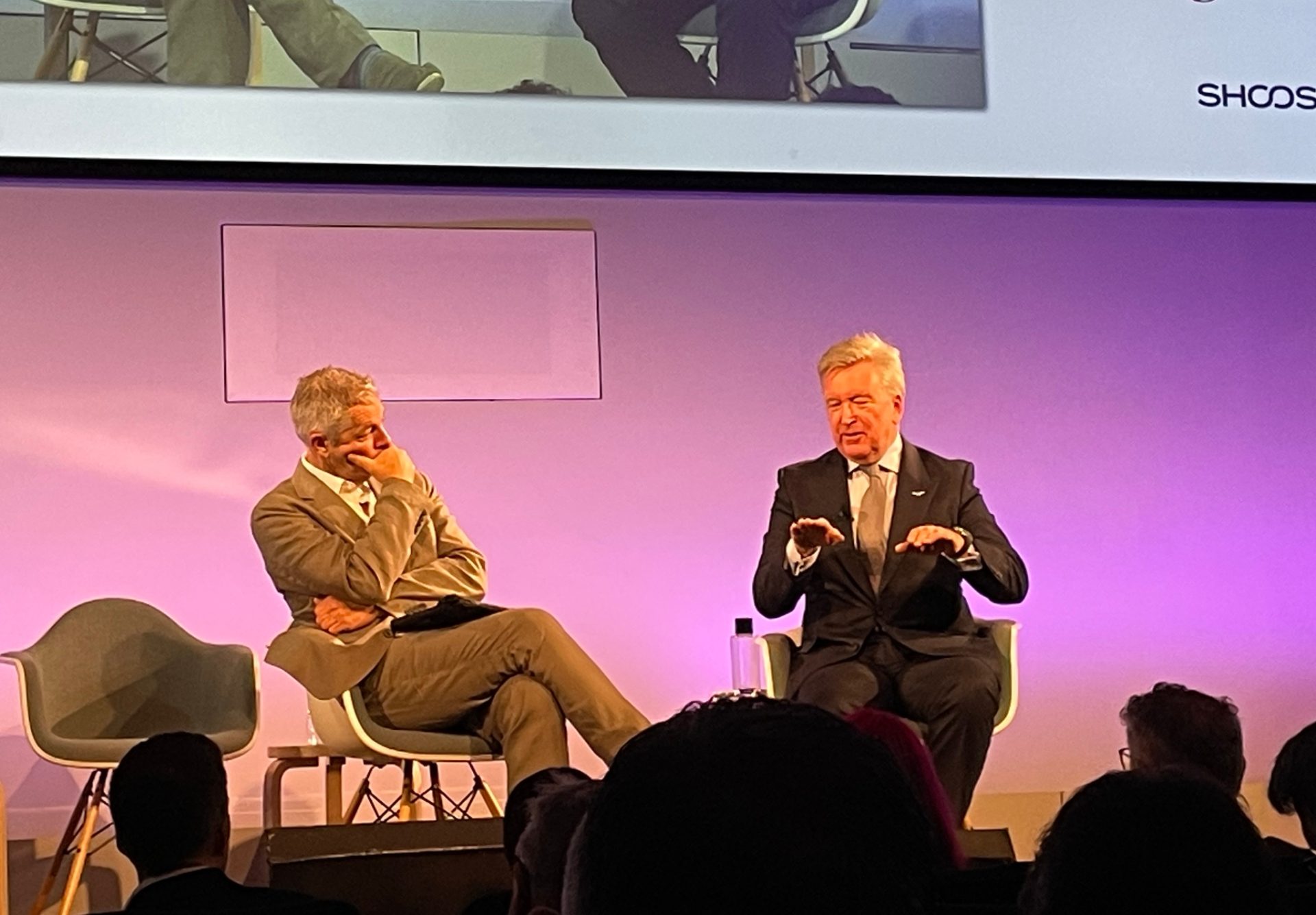
On the automotive landscape – Adrian Hallmark, CEO, Aston Martin Lagonda
- “We’ve entered a period that some have described as the reversal of globalisation, which means a rapid fragmentation of markets in a way that our business has never seen before. There’s a whole plethora of new challenges in what used to be a fairly consistent approach across the world – set on high standards – and that makes life difficult.”
- “In times of rapid change you have to act with dynamism, stay aware, be good at making judgments and hypotheses, and act upon them – while also managing risk on a day to day basis. It’s the big difference between ten years ago and today.”
Sustainability beyond the tailpipe
With increased focus on sustainability, coupled with new regulation, automotive manufacturers need to be able to report on their progress and the footprint of each vehicle; as assessment of their whole value chain. The panellists on this SMMT Automotive Summit session shared what their organisations are already doing in relation to Scope 2 and 3 emissions, circularity and energy sourcing and what more will be needed over coming years.
Alison Nuttall, Head of Sustainability Global Affairs, JLR
- “Through our reimagined strategy, JLR has set out a clear pathway to modern luxury with sustainability at its core. Our sustainability journey has got three critical steps – the first is to have pure electric vehicle available in all brands by 2030, to be zero tailpipe emissions by 2036 and then to be net zero carbon emissions by 2039 across supply chain, product and operations.”
- “From an operational point of view, we are 23% down in our operational carbon emissions, and we’re seeing some amazing process changes in the sourcing of our materials within our supply chain. We’re really embedding sustainability data into our sourcing processes, and we’re also seeing a cultural transformation across all of our employees to really have sustainability as a value. And of course, as we prepare to launch our new electric vehicles, those tailpipe emissions, which, of course, are currently a big part of our emissions, are going to start rapidly declining.”
- “Data and transparency is a huge challenge, and it’s one that we’re all on at the moment. But through that data maturation we will be able to identify the opportunity both for emissions reduction and mitigation, but also in terms of adaptation. How you then turn that very complex, huge masses of data into something simple and understandable for the customer is really important. And in the luxury space, there is an expectation from the customer that we will take care of it.”
Vanessa Butani, Head of Global Sustainability, Volvo Cars
- “We are going all electric. We currently have six electric cars on market and we have four more coming online before 2030. Almost 50% of our sales last year were electrified vehicles, so we’re well on our way. We’re also aiming to be net zero and fully circular by 2040.”
- “We see also decarbonisation and sustainability as an opportunity for us to grow. It’s decarbonising our products as well as our own operations and really helping to drive change in society.”
- “Since 2019 we’ve been publishing lifecycle analysis for each of our electric vehicles which really helps us to show transparency; having the data which we can pull out at the right time, to the right customer. And that also helps us to understand where the big impacts are along the value chain, and how can we address those.”
- “We’ve also tried to make that date more tangible and interesting to customers with our battery passports, which we launched last year with the EX90. Each vehicle has a QR code inside the door and with the help of blockchain technology, users can follow the minerals in the car back to the mine to know where they came from, they can find out about the health of the battery and how much recycled material is included.”
Mick Flanagan, Vice President Customer Group, Adient (global automotive seating supplier)
- “We’re in the early stages of our sustainability journey. We’re trying to focus on the layers we can control, and we’re looking for ideas in our operations that are scalable. Last year, we conducted over 1,500 such projects and reduced our global CO2 emissions by about 7,400 tonnes. So scalability of those individual ideas is what’s really important to us.”
- “Another area of focus, is trying to make sure that we have complete and accurate data that we can measure, hold ourselves accountable for progress and also be transparent in our reporting. Around that data piece, we’re committed to the Science-Based Targets Initiative (SBTi), and we’re committed to reducing our Scope 1 and 2 emissions by 75%, and our Scope 3 emissions by 35% by 2030.”
- “Automotive is the third largest user of plastics in Europe, and in a premium luxury vehicle, there is upwards of 300kg of plastics and polymers. Within that there is around 42kg of seat foam, so we’re a big part of that recyclability challenge. To that end we’ve created an industry-first, closed loop recycling of those foams.”
David Johnson, Head of Public Affairs, Michelin Tyre
- “We have a broad range of sustainability commitments, based around milestones of 2030, 2040 and 2050, and we publish updates to those every year. So sustainability is absolutely a long-term strategy. But we also see it very much see it as a route to sales today and tomorrow. For example, if we introduce a tyre that is very low rolling resistance, it benefits the customer because they use less fuel. If we introduce a tyre that is low abrasion, there are fewer particulates going into the environment, but equally the tyre lasts longer. So planet and profit are completely interlinked.”
- “The highest profile emissions of tyres these days is particulates; the particles that are formed as a function of the grip with the road. Therefore, reducing those particulates is particularly challenging without harming safety. That challenge becomes even greater with EVs, of course, with the added torque and the added weight of the vehicle. But also, road surface is important, driving behaviour is important and road management is important, so it’s an industry issue. There’s a lot of research going on and collaboration between companies and academia, however, I do feel there’s a lot of duplication with that at the moment and I’d like to see it far more focused and accelerated.”
ZEV transition
As all segments of the automotive market undergo a pivotal transformation, understanding the dynamics of buying trends is more critical than ever. This panel delved into key factors shaping the market as a whole and what is needed to improve uptake. The session analysed buyer behaviour in relation to zero emission vehicles and what can be done to stimulate the market.
Simon Villanueva, Legal Director, Europe South Sales, Volvo Group Trucks
- “In terms of electric truck uptake, we’re certainly not where we thought we would be, and we expected it to take off far quicker than it has. What’s going on? On the negative side, our products are still very expensive, so it’s difficult for our customers to get a good TCO. Energy costs have been part of that and as such, it’s not a great time to be investing in expensive assets.”
- “On the sort of more positive note, there’s lots of use cases for gas trucks. And perhaps some of our customers who would otherwise be buying zero emission vehicles are going that direction. But these don’t work for the long-term as there are combustion balances coming in 2035 and 2040, so we really need that zero emission sector to take off.”
Damien O’Sullivan, Managing Director, Volkswagen Group UK
- “On the consumer side there are things to celebrate and progress has been made in terms of the move towards EVs and we’ve seen growth in demand for electric vehicles this year. We’re certainly moving towards more affordable EVs, but there’s still a big gap in terms of retail buyers being able to access electric vehicles, so we need stimulus for them in the form of much lower tax rates or the exclusion of VAT. That’s the adoption taken in Norway, for example, which is the leader in terms of electric vehicle adoption. Whether our government is in a position to go that far considering the current economic situation is questionable, but certainly offering incentives for customers to make the change is key.”
- “The alternative is what we’re seeing right now, which is consumers postponing a change of vehicle completely, leading to an older fleet of cars on the roads instead of having a fresher fleet of electric vehicles. They also need to look at incentivising charging infrastructure to have more points available, and take away any opposition to charging as well.”
For more articles like this, visit our Leadership channel


