
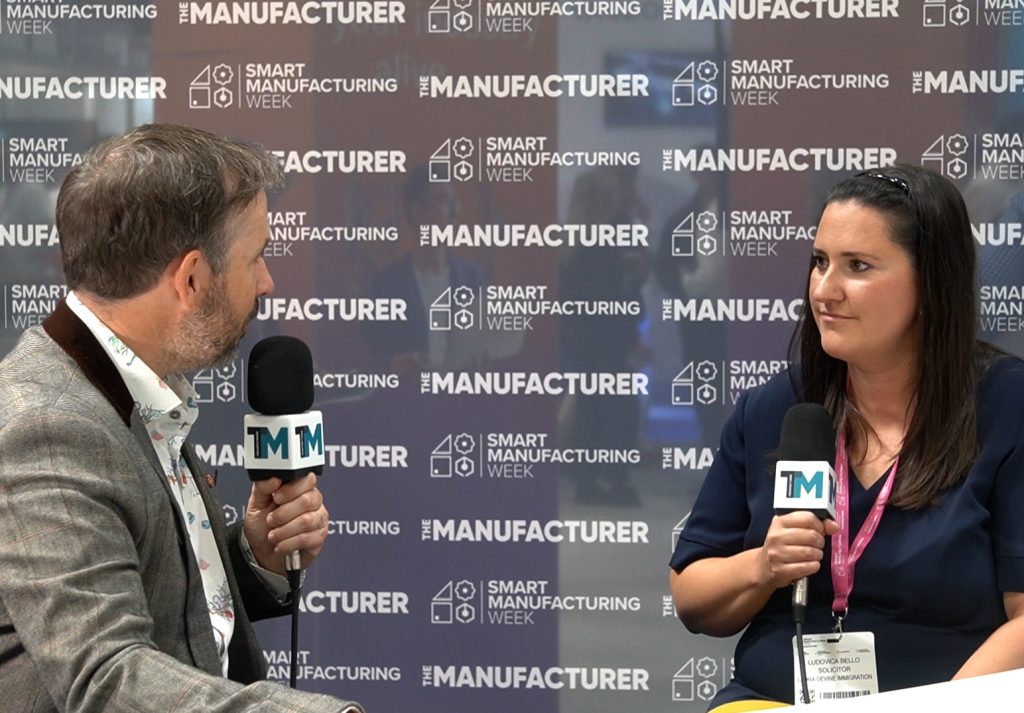
Ludovica Bello is Solicitor with Laura Devine Immigration, a law firm that deals exclusively with immigration law for both UK inbound and US inbound immigration.
What is your take on the current skills challenges facing UK manufacturing and how they are linked to immigration?
LB: Within the recent Industrial Strategy, the government has identified advanced manufacturing as a key area for growth. The manufacturing sector has historically been very reliant on immigration to fill workforce gaps and we assist companies in securing the permission needed for migrant workers. One of the unique characteristics of manufacturing is that the sector recruits from very low-waged to very highly skilled labour, and everything in between.
Traditionally, many of those lower-waged roles were filled by EU workers. Of course, since Brexit, it’s been more difficult for EU workers to come to the UK, and while those that were already here pre-Brexit were able to stay (for the most part), it has created more vacancies within UK manufacturing as many jobs are now not eligible for work visas. At the higher skilled end of the spectrum, the sector is still struggling to attract enough candidates for STEM-based roles, so the sector is facing vacancy problems across the board.

In our experience, UK businesses are definitely finding it harder to recruit and vacancies have been increasing across many sectors, particularly in manufacturing. There are immigration work routes that are designed to tackle those issues. However, what we’ve seen is that the market needs don’t always align with immigration policies which, over in the last few years, have been particularly restrictive, and that’s a trend that seems to be continuing with the current government.
What are the implications of the government’s Immigration White Paper on the advanced manufacturing industry?
The White Paper is a document which sets out the upcoming changes and proposed reforms to immigration policy. Some of the White Paper proposals, such as the increase in skill and salary levels, have now been implemented into law, however some proposals have not yet been enacted and may still change.
The government has said that it will consult with stakeholders, and we’re actually hoping that some of those proposals might be pulled back, because while the government is trying to attract very highly skilled labour to the UK, on the whole the current immigration policy is looking to make immigration routes a lot more restrictive.
What changes have been made to Skilled Worker sponsorship?
The Skilled Worker route is the main work visa route available to businesses to bring in foreign nationals through sponsorship. However, the proposals in the White Paper are designed to make the requirements for sponsorship much more restrictive, so there are a variety of changes being proposed within this category.
For example, it is being suggested that for settlement, individuals would need to have ten years of residence in the UK instead of five, as it currently stands. English language, salary and skill level requirements are all being increased, as are sponsorship costs. So overall, it’s going to be much harder to sponsor skilled workers and to grant work visas. Skill and salary level increases have now been confirmed and we are still waiting for the other changes to be formalised.
What is the potential impact of the increase in the RQF skill level for manufacturers?
To be eligible for sponsorship, a particular job role must meet a skill level requirement. Until recently, this was set at RQF level 3, which is equivalent to A level standard. The new Immigration Rules which came into force on 22 July 2025 have increased this skill level to RQF level 6, which is the equivalent of degree level.
The main impact will be felt in mid-skill level jobs. For instance, welders and engineering technicians who can currently come from overseas on a work visa will no longer be eligible for sponsorship. The Temporary Shortage List (TSL) could potentially mitigate some of that impact, but it will influence the industry. Welders and engineering technicians have both been included in the Government’s new TSL.
Can you explain the Temporary Shortage List (TSL) for lower skilled roles and its likely impact?
Certain jobs that are in shortage in the UK (as identified by the Migration Advisory Committee), will be placed on the TSL so that even if a role doesn’t meet specific requirements such as the skill level or salary requirement, a business may still be allowed to recruit from overseas in order to fill that vacancy.
Something that’s changed compared with previous versions of shortage occupation lists is that it will be temporary in nature, the current version will last until December 2026. Migrants who are sponsored on this list will not be able to bring family members with them to the UK. They will also have restrictions in terms of supplementary employment and may not be eligible to settle in the UK. It seems to present a temporary solution to what is a very long-term problem.
Another difficulty is that businesses will need to overcome a variety of obstacles in order to make use of the TSL. Firstly, the Migration Advisory Committee must determine that there are long-term and persistent shortages in the sector. In future, businesses will also be required to demonstrate compliance with a sector workforce plan . Broadly, that means they will have to prove that they have already tried recruiting from within the UK, are investing in domestic workforce training programmes and trying to recruit from the economically inactive.
If they meet all those criteria, they may be able to recruit from the TSL. But in future when the requirement to comply with a sector workforce plan is introduced, some businesses, particularly smaller and medium enterprises, may not have the resources to invest in such training programmes and therefore may not be able to make use of the list.
What will the Immigration Skills Charge (ISC) increase of 32% mean for foreign worker recruitment?
The Immigration Skills Charge is already one of the highest costs associated with immigration sponsorship. It is essentially a tax that’s applied to businesses who want to sponsor foreign workers – the idea being that the tax is then reinvested into training the domestic workforce.
The maths is very easy as most businesses would currently pay £1,000 per worker, per year. However, that’s just one cost of many across the immigration process. An increase of 32% is significant, and it will potentially mean that some will simply not be able to afford to recruit from abroad.
Indirectly of course, that’s one of the aims of the current government, because it has talked about wanting to bring net migration numbers down. So, in increasing the cost for sponsoring foreign workers, the government is also hoping that businesses increasingly turn to the domestic workforce.
However, the problem with an industry like manufacturing is that vacancies are already there, and employers are trying to recruit domestically without success in many cases. So it may just create additional costs for those businesses that are already in a situation where they simply can’t fill the vacancies they have.
What does the future look like?
It should be said that the White Paper is not all bad news. With the government wanting to attract more highly skilled labour, it is also expanding and making more flexible some of the highly skilled worker routes, such as Global Talent visas, High Potential Individual (HPI) visas and Innovator Founder visa.
Another positive development is the expansion of Youth Mobility Schemes, typically targeting younger migrants aged between 18 and 35. They’re able to come to the UK for a period of two or three years, and they have a virtually unlimited range of activities they can do, including working, studying or being self-employed. This could potentially be really useful for the manufacturing industry to fill skills gaps at all levels.
The Youth Mobility Scheme route is being expanded because the UK has agreed a number of new trade deals. For instance, the recent Indian Trade Agreement has given rise to the Indian Young Professional Scheme, which facilitates young Indian nationals coming into the UK for work. And more recently, the EU/UK trade deal that was agreed will also have an element of Youth Mobility Scheme included within that and will help attract younger EU migrants to the UK. This could really help to plug some of the vacancies and the workforce gaps within manufacturing.
Watch the video interview here.
For more articles like this, visit our Leadership channel.