
Waste not, want broth: Borough Broth’s journey from kitchen to supermarket

Posted on 16 Jun 2025 by Molly Cooper
Company: Borough Broth

Over ten years ago Ros Heathcote began making her own bone broth following a friend’s recommendation. Now, Borough Broth has grown into a £5m business and is stocked in many major supermarkets. The Manufacturer visited its manufacturing site in London to find out about its operations and growth.

At The Manufacturer, we visit many sites that produce a variety of amazing smells – from strawberry Strepsils at Reckitt to bath bombs at LUSH. However, the waft of bone broth simmering away must be one of the best. Ros Heathcote is the Founder and Managing Director of the company, an organic slow food business, predominantly making bone broths as well as soup bases, cooking fats and other low fodmap options – a diet designed to identify and limit specific types of fermentable carbohydrates (FODMAPs) that can cause digestive distress. The company also works alongside another brand called Spice Box, which manufactures curries and dhals.

Key takeaways

  • Ros Heathcote began making bone broth over a decade ago as part of a personal health recovery journey. This evolved into a £5m business
  • Borough Broth is a zero waste and B Corp certified business. It upcycles meat industry byproducts and sends its production waste to be converted into renewable energy and fertilisers.
  • The company exclusively uses British organic farms for its ingredients, including meats and spring water. This not only supports UK agriculture but ensures product quality and traceability
  • Starting with Ocado in 2017, Borough Broth has grown significantly, now supplying to major UK supermarkets like Waitrose, Sainsbury’s and Tesco, while maintaining control over its manufacturing processes
  • Despite challenges such as rising fuel costs, supply chain disruptions and new packaging regulations, the business remains agile, preferring small-batch production and resisting compromises like shortening its 24-hour cooking process

FAQs

  • What exactly is bone broth and how does it differ from regular stock?
  • How did Borough Broth get started and what inspired its founder?
  • What sustainable and zero-waste practices does Borough Broth follow?
  • How does Borough Broth manage its supply chain relationships and logistics?
  • What challenges does Borough Broth face with regulations like Extended Producer Responsibility (EPR)?

Some of you may be wondering, what is bone broth? Ros explained that it’s a very nuanced version of stock, with the key difference being the amount of cooking time. “It’s ultimately meat, bones, vegetables, water and seasoning. Our broths here are slow cooked for 24 hours and they’re seasoned to be sipped like a tea or they can be used as a ‘posh’ stock as a base for meals”, she commented.

All of Borough Broth’s products are organic certified and the company only works with British organic farms. “We predominantly produce organic chicken and beef bone broth, but we also have organic lamb and duck flavours as well as sustainably caught fish broth.” In addition, the company produce noodle soup bases such as Vietnamese chicken pho broth and Japanese inspired tonkotsu ramen broth made from organic British pork.

Beginning the broth

Ten years ago, Ros found herself developing allergies, struggling with her digestion and feeling inflamed. Alongside stripping back her diet, eliminating certain foods and finding others to help improve her condition, a friend recommended drinking bone broth as part of the process.

Looking back, Ros feels that it was one of the foods that really helped sustain her health and regain her strength. As a business, Borough Broth makes no snake oil-type claims and lets its customers do their own research into the benefits of bone broth. However, Ros is in no doubt as to its potential. She added: “One of the qualities of bone broth is that it is full of collagen. This comes from the gelatin in the bones and there is more evidence coming to light all the time about its ability to aid digestion, heal your gut lining, reduce inflammation and induce your body’s own production of collagen. Many think collagen is just for hair, skin and nails but it is also in your joints.”

Many of us have heard the old wives tale that chicken soup is best when you have a cold, but it’s no myth. “Chicken broth has been proven to reduce the amount of mucus that your body produces, helping to aid recovery from congestion”, Ros added. “Drinking it helped my digestion and reduced a lot of inflammation. I was making it every day and cooking it overnight in slow cookers in my kitchen.”

After speaking with her butcher who was supplying Ros with the bones to make the broth, they came to an agreement; she helped him with his website, and he gave her as many free bones as she needed (as they would only have been thrown away).


Ros Waitrose Launch (1)
Ros Heathcote, Founder and Managing Director, Borough Broth

Ten years strong

Borough Broth has always manufactured each of its products in-house, and with growing demand it has moved three times over the last decade. “This is our third expansion in our current site. We INNOVATIONhave been manufacturing here since 2020, and in 2017 we secured our first big customer, Ocado, and have grown exponentially with them” said Ros.

In that period, Borough Broth developed and launched a co-branded range with Mindful Chef back in 2020 and similarly a co-branded range with Holland & Barrett in 2023. “Two years ago, we launched in Waitrose and at the beginning of this year, we got our products into Sainsbury’s. And next month, we launch with Tesco.”

Zero waste business

The business was born from taking an unwanted byproduct of the meat industry and using it in human food, rather than going into the waste stream or being used for pet food.

“Our foundation was based around taking a waste product and reusing it. And even the byproduct from our own processes – the leftover cooked bones and vegetables – get taken from our site to East London to a giant bio-digester. That then anaerobically processes all our waste food and turns that into a mixture of liquid fertilisers and methane gas”, Ros explained. This methane is then cleaned and put back into the grid, which can fuel up to 1,000 homes a year.

The company is B Corp certified, meaning that Borough Broth is verified by B Lab to meet high standards of social and environmental performance, transparency and accountability. “For me, I have reservations about a net zero target, because as a manufacturer, you do have an environmental impact, and it is becoming easier for that to be covered by offsetting. But for us, I want to focus on reducing our impact first in whatever way we can”, Ros added.

Supply chains

Borough Broth’s manufacturing relies heavily on its suppliers. It works closely with numerous meat producers across the UK and is always open to different ways of working as the company expands.

“We have great relationships with our suppliers, and we’ve worked closely with them on a case-by-case basis of what works for them and for us. We want to make it as easy as possible for us to receive the products and to ship them in the most sustainable way”, explained Ros.

As such the company ensures that it fills lorries rather than just loading one pallet, uses less fossils fuels, reduces labour and packaging costs, and makes the partnership mutually beneficial for both parties. “We are taking a waste product away so they no longer need to pay any disposal costs.”

Like every other manufacturing business, Borough Broth has faced some challenges. “Rising fuel costs made logistics more difficult with our suppliers and there was a recent CO2 shortage which caused us some issues. Avian flu is always posing a risk to us with regards to the supply of our chicken bones,” said Ros.

Borough Broth found the COVID pandemic particularly challenging when it came to staffing. Ros believes this was due to the number of workers that left the UK after Brexit, making the employability pool smaller. The company currently doesn’t import or export outside of the UK so hasn’t felt the direct impact of Brexit on its shipping, but it supplies its products to places that do.


Borough Broth
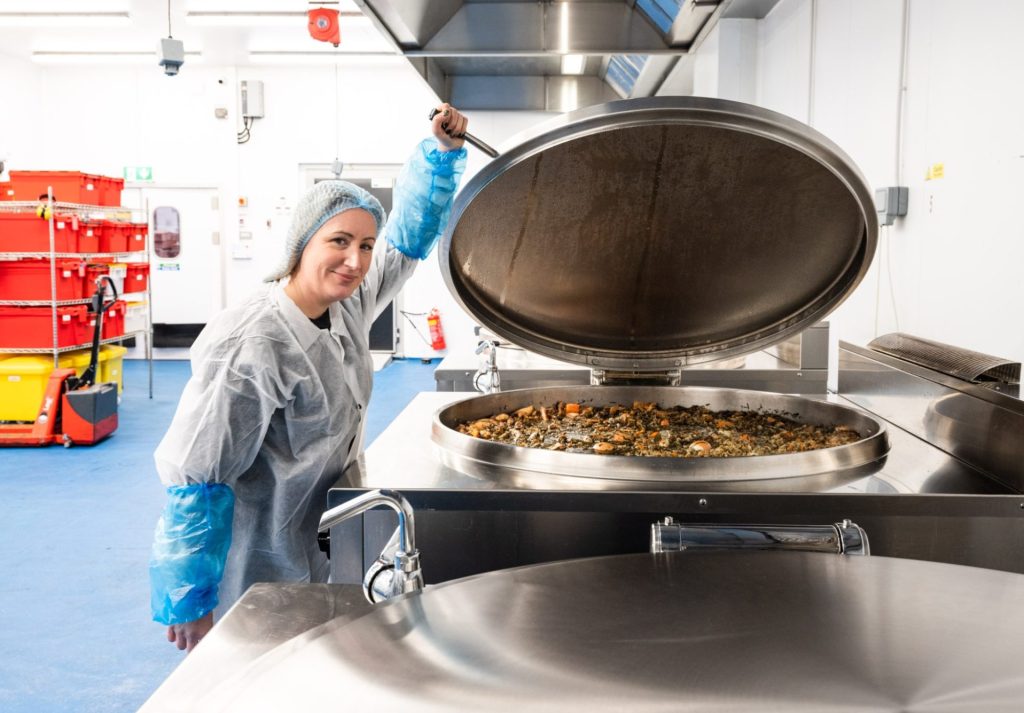
Borough Broth’s manufacturing facility in Greenford, London

Spring water

Borough Broth also uses spring water in all its broths. “From the very early beginnings of the business I have always used spring water. For me it was a taste preference but now, from the perspective of our customers, when they are concerned about health, it’s important to only put the best in your body”, said Ros.

The company used to purchase water cooler bottles and tip them into bratt pans but now, it has found the best quality spring water that it could in the UK and ships it to the manufacturing site in large quantities for use. “We have found it makes a world of difference to our end products.”

Automating processes

In the UK food manufacturing industry, Borough Broth is a small player in comparison to some but that allows the company to be nimble and agile, working on smaller lines and shorter runs.

“We have brought in automated equipment in some areas, but automation fundamentally lends itself more to very large runs and in turn, full automation would mean that we’d be unable to do bespoke ranges or collaborations. We could end up producing a run of 100,000 units when we only needed 500”, said Ros.

As a no waste manufacturer, this flexibilty is key and means that Borough Broth never throws anything away and only makes what it needs. “There are elements in production that we’re going to automate, but there will always be that human touch to what we do”, she added.

Scaling up

Originally, Ros didn’t set out to manufacture the bone broth herself. “In the early days when I was approaching other manufacturers – predominately those making soup or stock – they were always challenged on how long we were cooking the products.”

However, it is the 24-hour cooking time that gives Borough Broth one of its unique selling points. The length of cooking time did come with its challenges when the business was first growing because it needed to make more batches, quicker. “The obvious solution would have been to shorten the cooking time, but we have done so many tests, and it made such a negative difference in the quality of the product; and I was not willing to compromise on that.”

Ros now loves the fact that the company manufactures the products in-house as it has given her full control over production and in how the company moves forward. The business has now expanded to 18 bratt pans at its manufacturing site to help it keep up with demand and is looking to relocate once more within the next 12 months.

EPR regulations

The imminent extended producer responsibility (EPR) for packaging is a particular challenge for food and beverage manufacturers (as outlined earlier in this issue). However, Borough Broth uses lightweight, flexible plastic packaging, which is the most sustainable option for the business and is a low impact product.

“EPR is calculated on weight and each material has its own amount that you are charged. As such, we are much less impacted by the charges, compared to another company that might be using glass for example.”

However, the company does produce some items in glass jars, like its 100% organic fats, so EPR’s impact on the business will not go unnoticed. “For now, what is most concerning is that there is still a lot of uncertainty about what we’re going to be charged and when. It’s becoming increasingly hard to plan for.”

Roadmap ahead

The most recent addition to the product line has been the aforementioned organic fats range. Ros grew up in a home where her parents would cook using chicken fat and beef dripping; products that are now becoming more popular as a sustainable and healthy, low processed food and cooking ingredient. “This has always been something I wanted to do because fats are ultimately another byproduct of what we produce”, she added.

Another product range manufactured at the Borough Broth site is Spice Box, which Ros was previously purchasing from Planet Organic. “From there, I got introduced to the Founder, Grace Regan, and she was looking for a manufacturer after losing their previous contract. I was already a consumer, and it was a product I believed in. It was the perfect storm.”

When the company acquired Spice Box, it also brought on Grace and began to develop the full range to be 100% organic. “That was only a year ago and now we are stocked in Planet Organic and Whole Foods with a new big listing in the pipeline”, Ros continued. For Ros, the future is all about organic.

“We are a strictly organic manufacturing site, so the plan is to keep reaching more people, educate them on what organic means, get regenerative farming spoken about as a topic and continue to be a leader in sustaining UK soil because I believe organic is the way forward.”

For more articles like this, visit our Innovation channel