
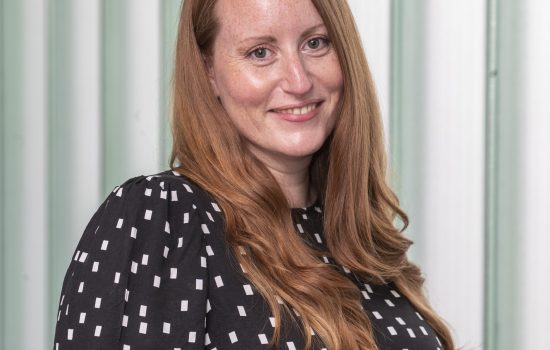

Job Title: Managing Director & Co-Founder
Company: DefProc Engineering
What is your background and how did you come to be in your present role?
I’ve had what people would describe as a squiggly career! My educational background is art and design, and I have done a variety of different roles.
My partner, and co-founder, has an engineering background, and we both wanted to start a business when we were 27. He started it, and then I grew it. And we’ve been running for 13 years.
We started off doing proof of concept prototyping, and then we started designing for regulatory testing across a whole host of different sectors.
We then won some funding, which was part of the Liverpool5G Health & Social Care Testbed. We were a company of one at that time. It became apparent that we needed somebody not just to deliver the engineering, but to actually plan the projects and run the business.
That was in 2018, from there our business has just grown. We’ve got all sorts of clients. We’ve worked on all sorts of interesting projects.
My role within that is in the business operations and development side of things. We’re still a very small company, with a team of five now. So, I wear lots of different hats.
What has been your greatest challenge so far in your career?
The challenge for us most recently has been the unstable economic and political situations. Obviously, we’ve had COVID which was hard. But 2024 was a really difficult year for us, just because it’s taken so long to get projects signed off.
When I first took on the role in 2018 it was very easy to get innovation projects signed off – it would take three months. Whereas our last project actually took 18 months to get signed off.
I think everything has shifted so much over the last five years. And each year has thrown up a completely different set of challenges that we never thought we’d be facing. It’s been a steep learning curve, but adapting constantly is the name of the game for us.
What has been your greatest achievement so far in your career?
I think our biggest achievement is how we’ve grown organically. We’ve never taken investment. We’ve been part of funded projects – we’ve had some Innovate UK funding to develop some of our own products. But we’ve been a sustainable business for 10 years, and we’ve grown gradually.
The team of five that we’re working with now have been together for four years. We’ve got that much needed stability within the business now.
Because we work in so many different sectors, it’s important that we retain our staff. We have a really diverse team as well, which is unusual in manufacturing. We have people from different backgrounds who are predominantly female.
How do you think we can raise the profile of careers in STEM?
People don’t really understand what engineering is. They don’t know about all the different types of engineering and the uniqueness that each person actually brings to engineering and production.
As a production manager, you could have a wide variety of career experience and be involved in making products across different sectors. You’ve got people working in firmware on embedded development. That’s an incredibly challenging field for brand new for brand new products.
There is a real lack of understanding that engineering brings products to life and makes them real. I’m from the design background, and our co-founder is from an engineering background. I have lots of ideas, and our clients have lots of ideas of the thing that they want. It’s engineering that allows those things to exist, to be robust, and to be manufacturable at scale.
I think we need to be shining a light on this. We wouldn’t have any of these products if it wasn’t for design and engineering.
What advice would you give to someone considering a career in manufacturing?
I think manufacturing is a really exciting field, particularly at the moment. There’s such a shift in terms of production methods, digitisation and sustainability. There’s an awful lot to get your teeth into, and you don’t necessarily have to have started in manufacturing, you can move into the sector from somewhere else relatively easily.
We’re still at the start of how manufacturing is going to be revolutionised and evolve over the next 10 years. And there are so many opportunities, because many manufacturers are begging for efficiency and different ways of thinking.